


A Parent-Friendly Guide to Working With Children Check
If you are a parent in NSW, you may have heard the term WWCC from schools, tutoring centres, sports clubs, churches, childcare centres, or activity providers.
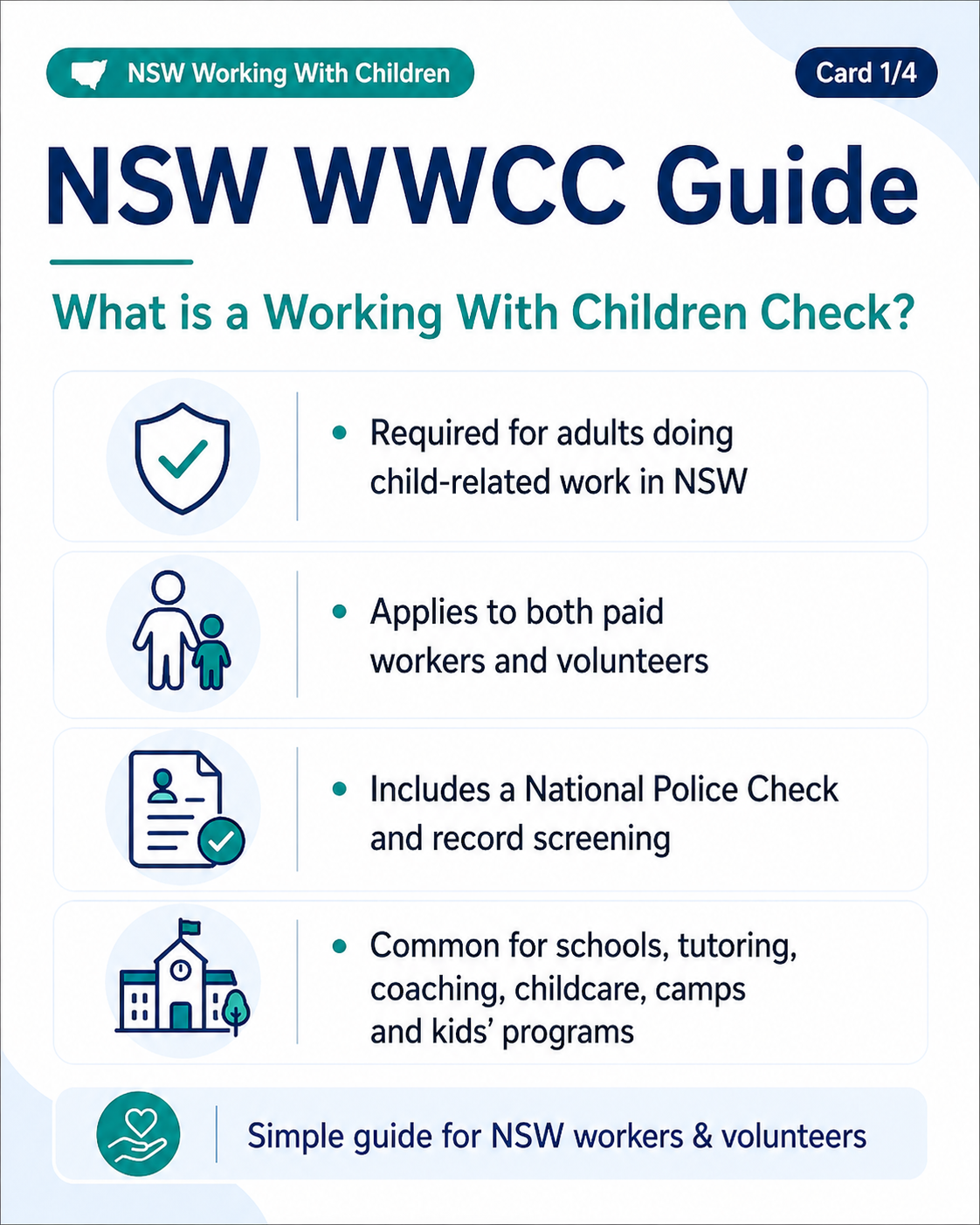
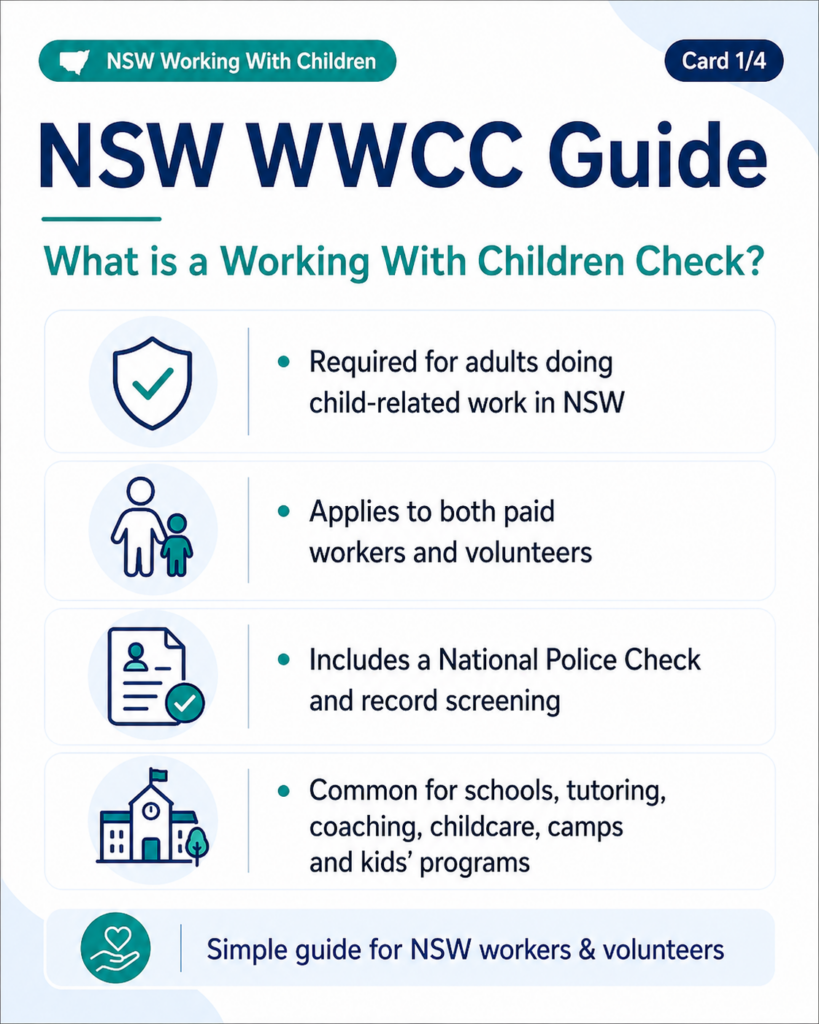
WWCC stands for Working with Children Check.
Before I became more familiar with it, I used to think it was just another government form. But as a mum, I now see it as something parents should understand — especially when our children spend time with teachers, tutors, coaches, volunteers, and activity leaders.
This guide is written from a parent’s point of view. It explains what a WWCC is, who may need one, why it matters, and what parents should know when choosing activities or services for their children in NSW.
Please note that this article is for general information only. Rules can change, so always check the official NSW Office of the Children’s Guardian or Service NSW website for the latest information.
What is the WWCC?
A WWCC, or Working with Children Check, is a screening requirement for people who work or volunteer in child-related work in NSW.
It is not just for school teachers. It can apply to many adults who work with children, including people in education, sport, tutoring, childcare, religious groups, community activities, and other child-related services.
The WWCC helps check whether a person is cleared to work with children in NSW.
As a parent, I think of it as one of the basic safety checks that should be in place when adults are working closely with children.
Why Parents Should Know About WWCC
AWhen we send our children to school, tutoring, sport, music lessons, camps, or other activities, we usually focus on the quality of the program.
Is the teacher good?
Is the class useful?
Is the place convenient?
Will my child enjoy it?
But safety is just as important.
A WWCC does not tell us everything about a person, and it does not replace parental judgment. However, it is an important part of child safety in NSW.
For parents, understanding WWCC helps us ask better questions when choosing a service for our child.
For example:
- Does this organisation work with children?
- Do staff or volunteers need a WWCC?
- Does the organisation verify WWCC details?
- Are child safety policies clearly explained?
- Do I feel comfortable with the environment?
These questions are especially important for activities outside school, such as private tutoring, coaching, after-school programs, holiday programs, and community groups.
Who Needs a WWCC in NSW?
In NSW, people who work or volunteer in child-related work may need a Working with Children Check.
This may include adults working in areas such as:
- schools and education
- childcare
- tutoring
- coaching and sport
- music or art lessons
- children’s camps
- religious or community groups
- youth programs
- health or disability services involving children
The exact requirement depends on the role, the type of contact with children, and whether the work is considered child-related under NSW rules.
It is also important to know that a WWCC is different from a Police Check. A person may need a WWCC even if they have already completed a Police Check.
Paid Work and Volunteer Work
WWCC can apply to both paid workers and volunteers.
This is important because many children’s activities involve volunteers — for example, sports clubs, school events, community activities, church groups, and holiday programs.
Some people assume that only paid staff need checks, but that is not always the case.
If an adult is doing child-related work, they may need a WWCC whether they are being paid or volunteering.
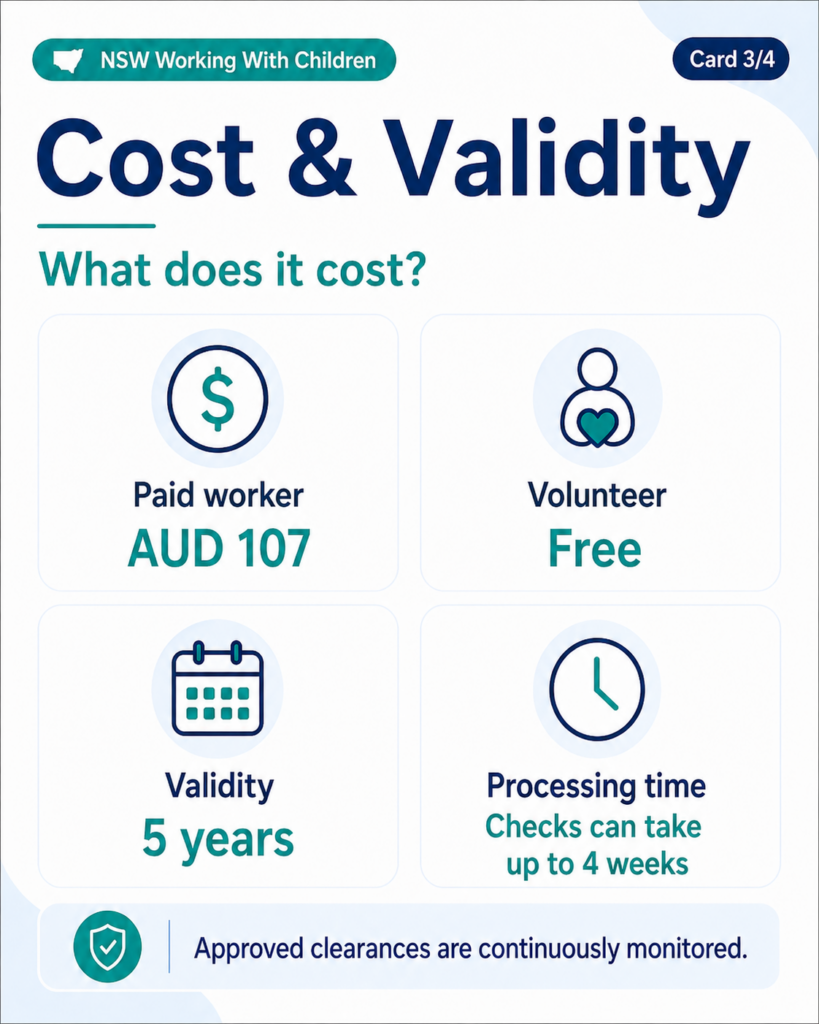
For volunteers, the application is free. For paid workers, there is usually a fee.
Before applying, it is best to check the official Service NSW or Office of the Children’s Guardian website to confirm the current requirements and fees.
How Long Does a WWCC Last?
In NSW, a Working with Children Check generally lasts for 5 years.
One useful thing to know is that the WWCC can move with the person. This means if someone changes jobs, they usually do not need a completely new check just because they moved to a different child-related workplace.
However, their employer or organisation still needs to verify their WWCC details.
This is an important point. It is not enough for someone to simply say, “I have a WWCC.” The organisation should verify it through the official system.
What Happens When Someone Applies?
When a person first applies for a WWCC, they receive an application number, often called an APP number.
According to the Office of the Children’s Guardian, a person can start child-related work once they have an APP number, while the application is being processed.
After checks are completed, if the person is cleared, they receive a WWC number.
The worker should provide their employer or organisation with their APP number first, and then their WWC number once it is issued.
As a parent, this helped me understand why some people may say they have “applied” even before the final WWC number arrives.
How to Apply for a WWCC in NSW
The process may change, but generally the steps are:
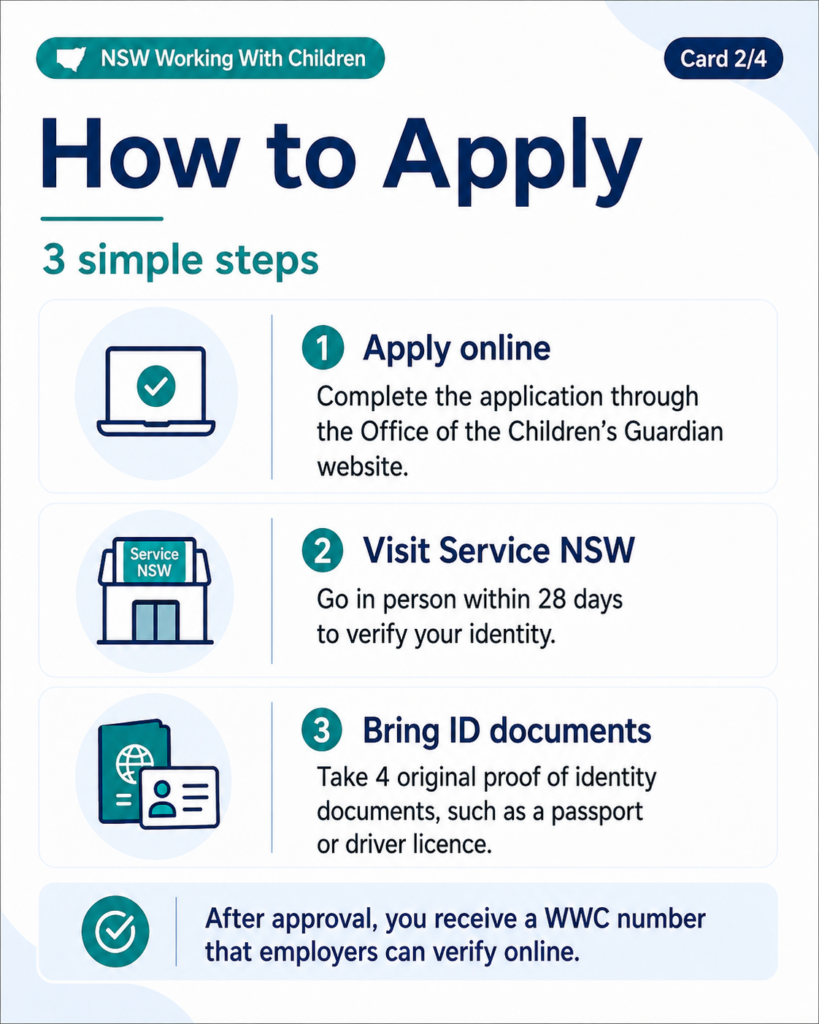
- Start the application online through the official Service NSW or Office of the Children’s Guardian pathway.
- Enter your personal details.
- Receive an application number or receipt.
- Prove your identity, usually through Service NSW if required.
- Pay the fee if the check is for paid work.
- Wait for the WWCC result.
- Provide the details to the organisation or employer.
When applying for the first time, you may need to complete the online form and then prove your identity with original identity documents.
Always check the official website before applying, because the process and fees can change.
Why Organisations Need to Verify WWCC Details
One thing I think parents should know is that organisations have responsibilities too.
It is not only the worker’s job to get a WWCC. Organisations that engage people in child-related work must verify WWCC details and keep records.
This matters because it creates a formal link between the worker, the organisation, and the child safety system.
So if you are choosing a tutoring centre, sports club, or activity provider, it is reasonable to expect that they understand and follow WWCC requirements.
You do not need to interrogate every person, but you can look for signs that the organisation takes child safety seriously.
What Parents Can Ask
If you are not sure whether a child-related service is careful about safety, you can ask simple questions.
For example:
- Do your staff have WWCC clearance?
- Are volunteer coaches or helpers checked?
- Does the organisation verify WWCC numbers?
- Do you have a child safety policy?
- Who should parents contact if they have a concern?
A professional organisation should not be offended by these questions.
As a mum, I think asking about safety should feel normal. We ask about fees, class times, parking, and homework policies. Asking about child safety should be just as normal.
My Mum Perspective
As parents, we cannot control every environment our children enter. But we can learn what basic safety systems exist and pay attention to whether organisations use them properly.
For me, WWCC is one of those things I did not think deeply about until my child became more involved in activities outside home and school.
Tutoring, sport, music, volunteering, school events — children meet many adults as they grow. Most adults are caring and professional, but systems still matter.
A WWCC does not guarantee everything. It is not the only thing parents should rely on. But it is one important layer of protection.
That is why I think parents in NSW should at least understand what WWCC means and when it may be required.
Final Thoughts
A WWCC is not just paperwork. It is part of the child safety system in NSW.
For workers and volunteers, it is an important requirement before doing child-related work. For organisations, it is something they need to verify and record properly. For parents, it is useful knowledge when choosing schools, tutoring centres, sports clubs, activities, and community programs.
As a mum, I believe we do not need to be anxious about everything, but we should be informed.
Understanding WWCC gives parents one more way to feel confident about the environments our children are spending time in.
Before applying for a WWCC or checking requirements, always visit the official NSW Office of the Children’s Guardian or Service NSW website for the latest information.
Official Sources Checked
Service NSW
NSW Office of the Children’s Guardian
*This article is based on general information and a parent’s perspective. It is not legal advice. Please check the NSW Office of the Children’s Guardian or Service NSW website for the latest WWCC requirements