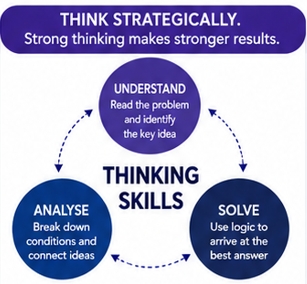


What matters more than solving many questions is the thinking process that leads to the right answer

Many parents want their child to become “good at maths” or “strong in English.”
But in NSW selective school, OC, scholarship, and high school preparation, one skill often sits behind every subject:
thinking skills.
Thinking skills are not just about being clever. They are about how a child reads a question, understands hidden information, connects ideas, eliminates wrong answers, and explains their reasoning clearly.
For many primary school students, especially those in Years 3 to 6, this can make a big difference.
What Are Thinking Skills?
Thinking skills include the mental habits students use when they solve problems. These may include:
- understanding what a question is really asking
- finding patterns
- comparing information
- making logical decisions
- identifying missing details
- explaining why an answer makes sense
- checking whether an answer is reasonable
In simple words, thinking skills help students move beyond guessing.
A child with strong thinking skills does not just ask, “What is the answer?”
They also ask, “Why is this the answer?”
Why Thinking Skills Are Important for Primary Students
Primary school is not only a time for learning facts. It is also the time when children build the way they approach problems.
In many school assessments, students are expected to apply knowledge in unfamiliar situations. This means memorising formulas, vocabulary, or grammar rules may not be enough.
For example, in a maths problem, a student may know how to multiply and divide. But if the question is written in a tricky way, the student first needs to understand the situation before using the correct operation.
In reading, a student may understand each word in a passage. But to answer deeper questions, they may need to infer meaning, understand the author’s purpose, or compare two ideas.
This is why thinking skills matter. They help students use what they already know in a smarter and more flexible way.
Thinking Skills and Selective School Preparation
For students preparing for the NSW Selective School Placement Test, thinking skills are especially important.
The test does not simply check whether a student has memorised school content. It often asks students to analyse, compare, reason, and solve problems under time pressure.
A student may face questions that look unfamiliar at first. In those moments, confidence comes from having a clear thinking process.
Good thinking habits can help students:
- stay calm when the question looks difficult
- break the question into smaller parts
- avoid rushing into the first answer
- recognise patterns or relationships
- check their answer before moving on
This does not mean every student needs to be naturally gifted. Thinking skills can be taught, practised, and improved over time.
Common Problems Students Face
Many students make mistakes not because they do not know the content, but because they do not think through the question carefully.
Some common problems include:
- Rushing too quickly
Some students read only part of the question and choose an answer too soon. - Guessing without a method
When a question looks hard, they may guess instead of using elimination or logic. - Not checking the question wording
Words such as “except,” “most likely,” “best,” or “not” can completely change the answer. - Using the wrong strategy
Students may try to solve every question in the same way, even when a different approach is needed. - Losing confidence
When students meet unfamiliar questions, they may think, “I can’t do this,” instead of trying to reason through it step by step.
These habits can be improved with guided practice.
How Parents Can Support Thinking Skills at Home
Parents do not need to teach advanced content every day. Sometimes, the best way to build thinking skills is through small daily conversations.
Here are some useful questions parents can ask:
- “How did you know that?”
- “Is there another way to solve it?”
- “Which answer can you eliminate first?”
- “What information is important here?”
- “Does your answer make sense?”
- “Can you explain your thinking?”
These questions encourage children to slow down and reflect.
Even when the answer is correct, asking “Why?” helps children understand their own thinking process. This builds stronger problem-solving habits over time.
Why Explanation Matters
One of the strongest signs of good thinking is the ability to explain.
When a student can explain their answer clearly, it usually means they understand the process, not just the final result.
For example, instead of saying:
“I chose B because it looked right.”
A stronger response would be:
“I chose B because the pattern increases by two each time, and the other options do not follow the same rule.”
This type of explanation shows logical thinking. It also helps teachers and parents understand where the student is confident and where they may need more support.
Thinking Skills Are Not Only for Exams
Although thinking skills are very useful for tests, they are not only exam skills.
Children use thinking skills when they:
- plan their homework
- solve problems with friends
- make decisions
- understand stories
- organise ideas for writing
- manage time
- learn from mistakes
In this way, thinking skills support both academic learning and everyday life.
A child who learns how to think carefully is better prepared not just for one test, but for future learning.
A Practical Way to Improve
The best way to improve thinking skills is through regular, structured practice.
This does not mean doing endless worksheets. It means practising questions that require students to think, explain, compare, and reflect.
A good practice routine may include:
- solving a small number of quality questions
- reviewing mistakes carefully
- explaining the reason behind each answer
- learning different strategies
- tracking repeated mistake patterns
- building confidence gradually
The review process is just as important as the practice itself.
If a child only checks whether an answer is right or wrong, they may repeat the same mistake next time. But if they understand why they made the mistake, they can improve.
Final Thoughts
Thinking skills are one of the most valuable skills primary school students can develop.
They help children become more independent learners, more confident problem solvers, and more thoughtful readers and writers.
For parents preparing their child for OC, selective school, scholarship tests, or general academic improvement, it is worth focusing not only on what children learn, but also on how they think.
Because in the long run, students who think deeper often solve smarter.